Difference Between Retail & Bank Trading

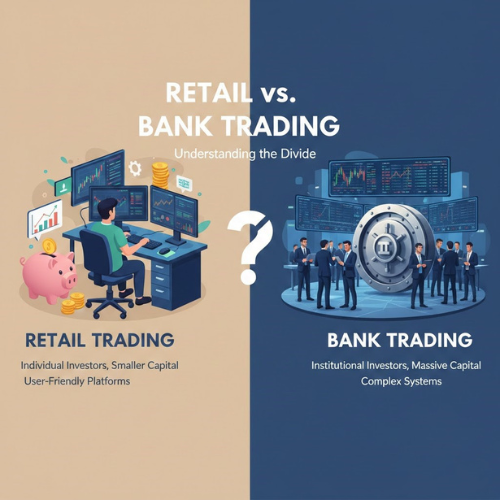
Title: Difference Between Retail and Bank Trading
Forex trading is dominated by huge banks and institutions, but most individual traders participate through retail accounts. Understanding the difference between retail and bank trading is essential for seeing how the market really works.
Bank Trading involves large financial institutions, hedge funds, and central banks that trade millions or billions of dollars. These players have access to deep liquidity, advanced tools, and real-time market data. Their trades can move the market, influence trends, and create opportunities for retail traders to follow. Banks often use strategies like hedging, arbitrage, and smart order placement to manage risk and maximize profit.
Retail Trading, on the other hand, involves individual traders using smaller accounts through brokers. Retail traders typically use leverage to trade larger positions than their capital allows, but their trades are too small to influence the market. They rely on brokers for access to pricing and liquidity, often through spreads or commissions. Retail traders face more challenges, such as slippage, emotional pressure, and competing with professional traders who have far more resources.
Another key difference is information and analysis. Banks have access to institutional-grade data and proprietary models, while retail traders mostly rely on public charts, indicators, and news.
In short, bank trading operates on a massive, strategic scale, while retail trading is smaller, more reactive, and vulnerable to the movements created by institutions. Understanding this gap can help retail traders align strategies and avoid common mistakes.