Bretton Woods System Explained

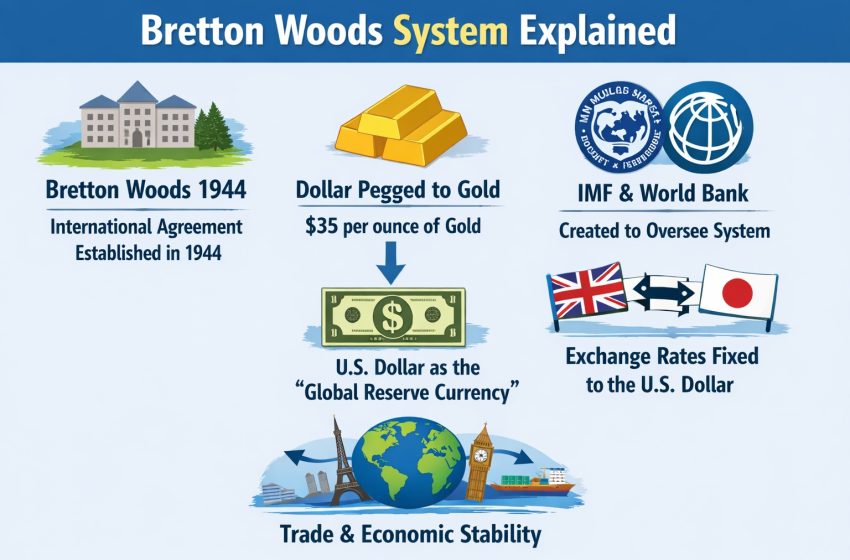
The Bretton Woods System was a landmark agreement that shaped the modern global financial system. Established in 1944 at a conference in Bretton Woods, New Hampshire, it brought together 44 Allied nations near the end of World War II to create a stable international economic framework.
Under this system, currencies were pegged to the US dollar, and the dollar itself was convertible to gold at a fixed rate of $35 per ounce. This made the US dollar the world’s primary reserve currency, providing stability and predictability for international trade and investment. The system also led to the creation of key institutions like the International Monetary Fund (IMF) and the World Bank, which were designed to help countries manage exchange rates, provide financial support, and rebuild post war economies.
The Bretton Woods System worked well for two decades, helping promote economic growth and stability after the war. However, by the late 1960s, the system faced challenges. The US experienced inflation and trade deficits, making it difficult to maintain the dollar’s gold convertibility. In 1971, President Nixon ended dollar-gold convertibility, effectively ending the Bretton Woods System and ushering in the era of floating exchange rates.
In essence, the Bretton Woods System laid the foundation for the modern financial world, emphasizing cooperation, stability, and international economic growth.